- The Middle Path
- Posts
- The Middle Path #2 - Khilafah: Sustainability and Climate Change
The Middle Path #2 - Khilafah: Sustainability and Climate Change
Moving Towards a Sustainable Future

Faizan Siraj
19 Oct • Estimated Reading Time: 9 minutes
Assalamu'alaikum / Hello,
1. Climate Change - Should we Care?
Climate change is a term that's tossed around frequently. But is it really a crisis? Or just another sensationalised topic? Let’s break down some facts and myths, and see if investing in climate solutions truly makes sense.
There’s no shortage of debate on climate change. While most scientists agree that climate change is a result of human activity, skeptics argue that the science is inconclusive or exaggerated. However, the data is clear: according to the World Research Institute, global temperatures have risen by 1.48°C since the pre-industrial era, putting us dangerously close to the 1.5°C threshold, that could trigger irreversible damage to ecosystems.
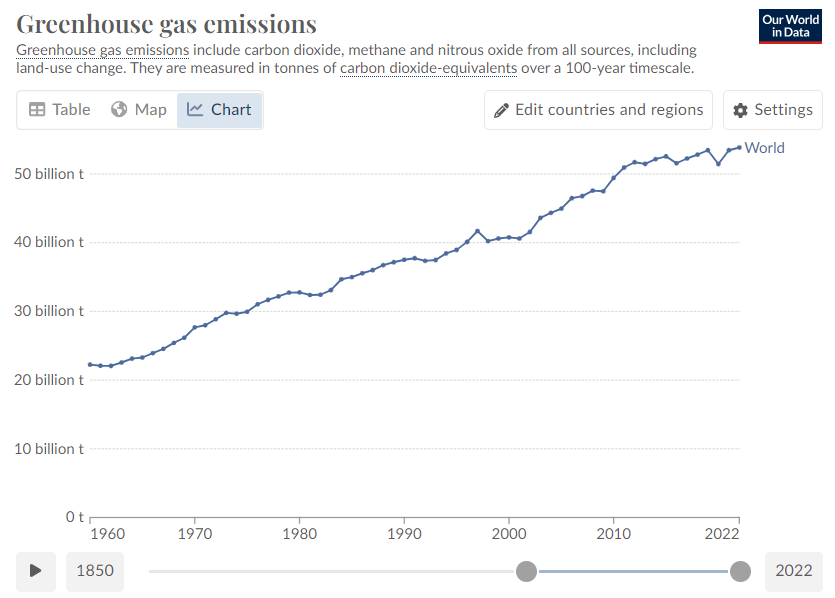
Some say that natural climate cycles are responsible for this warming. While Earth has certainly gone through warm and cool periods, the rapid temperature increase over the last century doesn’t match natural patterns. The two charts below show the rise in the global average temperature (>1.2o C), alongside the clear rise in greenhouse gas emissions (~30bn tonnes) from 1960-2024.

Investing in Climate Tech: Worthwhile or Wasteful?
Climate skeptics often argue that the cost of transitioning to renewable energy is too high and will hurt the economy. Yet, research shows that inaction will likely cost us much more. For instance, 2023 saw a record number of billion-dollar weather disasters, which impacted communities, infrastructure, and economies around the world. Just this last week, the damages in the US caused by Hurricanes Helene and Milton have caused damages estimated to be more than $100bn, and the US government have been criticised for their level of support and preparedness for the disasters (NBC News).
The following section will break down what all of this means for us as Muslims.
2. Did you know?
Islam teaches the concept of Khilafah, or stewardship, which describes the role of humans as custodians of the Earth, entrusted by Allah. The Quran and Hadiths encourage avoidance of waste, and the preservation of natural resources, as reflected in the following verses:
“يَـٰبَنِىٓ ءَادَمَ خُذُوا۟ زِينَتَكُمْ عِندَ كُلِّ مَسْجِدٍۢ وَكُلُوا۟ وَٱشْرَبُوا۟ وَلَا تُسْرِفُوٓا۟ ۚ إِنَّهُۥ لَا يُحِبُّ ٱلْمُسْرِفِينَ"
“O Children of Adam, take your adornment at every masjid, and eat and drink, but be not excessive. Indeed, He likes not those who commit excess.”
Surah Al-A'raf (7:31) - Sahih International
“هُوَ ٱلَّذِي جَعَلَكُمْ خَلَـٰٓئِفَ فِى ٱلْأَرْضِ ۚ فَمَن كَفَرَ فَعَلَيْهِ كُفْرُهُۥ ۖ وَلَا يَزِيدُ ٱلْكَـٰفِرِينَ كُفْرُهُمْ عِندَ رَبِّهِمْ إِلَّا “مَقْتًۭا وَلَا يَزِيدُ ٱلْكَـٰفِرِينَ كُفْرُهُمْ إِلَّا خَسَارًۭا
“It is He who has made you successors upon the Earth. So whoever disbelieves – upon him is [the consequence of] his disbelief. And the disbelief of the disbelievers does not increase them with their Lord except in hatred; and the disbelief of the disbelievers does not increase them except in loss.”
The first verse emphasises the importance of moderation and avoiding wastefulness, which aligns with sustainable living and responsible consumption, values central to environmental stewardship in Islam. The second verse emphasises humanity's role as caretakers and successors on Earth, highlighting the responsibility to protect and sustain the environment as a trust from God.
In early Islamic society, the principles of Khilafah (stewardship) and avoiding excess were deeply embedded in daily life, emphasizing the community’s role in caring for the Earth and maintaining balance in consumption. These values were not only preached but also practiced by prominent figures of the time.
During the time of the Prophet Muhammad (peace be upon him), the concept of Khilafah was evident in the way he and his companions treated natural resources. The Prophet taught us that the Earth and its resources are a trust from God and should be protected. For example, he prohibited the unnecessary cutting down of trees and promoted the sustainable use of water, even advising against wastefulness when making ablutions (wudu) for prayer. One prominent figure of the time was Abu Bakr Al-Siddiq (573–634 CE), the first Caliph, who upheld these principles rigorously. During his leadership, Abu Bakr issued a command to his armies forbidding them from damaging orchards, cutting down trees, or polluting water sources, even during times of war. His policies reflected a profound respect for the environment and the resources that sustain life.
The principle of moderation, avoiding wasteful excess, was also crucial in early Islamic society. The Prophet Muhammad (pbuh) emphasized simple living and often spoke against extravagance. He himself lived modestly, often repairing his own clothes and shoes, and consuming only what was necessary. Another prominent figure in Islamic history who followed this concept was Umar ibn al-Khattab (584–644 CE), the second Caliph, who was known for his ascetic lifestyle and concern for the welfare of the environment and community. He encouraged Muslims to be mindful of their consumption, especially in times of scarcity. Umar often reminded people to eat and drink modestly, aligning closely with the Quranic instruction to avoid excess. For instance, during a time of famine, he restricted his diet to bread and oil, refusing to eat anything the general population could not afford.
So what can we do today, to follow in the footsteps of our Prophet and his successors? Below are a few practical suggestions (N.B. not an exhaustive list!):
Sustainable Consumption: Avoid overconsumption by practicing mindful eating and supporting local, ethical products. Reducing food waste and donating excess are ways to practice generosity and moderation
Conserve Natural Resources: Use water mindfully, recycle, and reduce waste. Small acts, like turning off lights when not needed and minimising single-use plastics, can collectively have a significant impact
Ethical Investing: Choose investments that align with Islamic principles and support sustainable, eco-friendly businesses. Islamic finance offers green Sukuk options, which are Shariah-compliant bonds that are specifically issued to fund environmentally responsible projects. C
ountries like Malaysia and Indonesia have led the issuance of green Sukuk to finance renewable energy projects, reforestation, and sustainable infrastructure development. Learn more about Sukuk options from Securities Commission Malaysia and about the concept from Investopedia.
If you want to read further on the concepts of Khilafah and moderation in Islam, the below resources may pique your interest:
"Green Deen: What Islam Teaches about Protecting the Planet" by Ibrahim Abdul-Matin. This book explores Islamic teachings on environmental responsibility and offers practical ways Muslims can incorporate these principles into their daily lives
Resources available on IFEES (Islamic Foundation for Ecology and Environmental Sciences), a UK based charity that has been active since the 1980s, dedicated to the maintenance of the Earth as a healthy habitat for all living beings

3. Iman Abuzeid→ Highlight of the Week
Spotlight on Iman Abuzeid: Revolutionizing Healthcare with Incredible Health
This week, we celebrate Iman Abuzeid, the co-founder and CEO of Incredible Health, a groundbreaking healthcare technology company that is transforming the way hospitals hire nurses. Founded in 2017, Incredible Health focuses on streamlining the hiring process, making it easier for healthcare providers to find and retain qualified nursing professionals, ultimately improving patient care.
Iman Abuzeid, with a background in medicine and engineering, founded Incredible Health to tackle the U.S. nursing shortage — a challenge that grew even more urgent during the COVID-19 pandemic. She leads the platform in using technology and data to connect nurses with hospitals, making the hiring process faster and more efficient.
Under her guidance, Incredible Health has earned recognition, attracting significant investment and partnering with top healthcare organizations. Iman’s work also earned her a spot on the TIME100 Next list in 2024.
Beyond her role at Incredible Health, Iman is a passionate advocate for diversity in tech and healthcare. She supports initiatives for underrepresented groups, creating a more inclusive space for aspiring professionals. Her story inspires many young women, especially in the Muslim community, to pursue careers in healthcare and tech.
Let’s applaud Iman Abuzeid for her remarkable contributions to healthcare innovation and her dedication to empowering nurses and fostering diversity in the industry!

Some companies that have recognised Incredibel Health
And that’s that! We hope this short 5-8 minute newsletter (every Jummah) will help you become more knowledgeable about current worldly affairs with a snippet of Islamic history, whilst giving out a burst of Muslim-positive energy!
We love learning and hope you do too. May Allah reward all of our efforts.
From The Middle Path team,
Assalamu'alaikum / Goodbye!